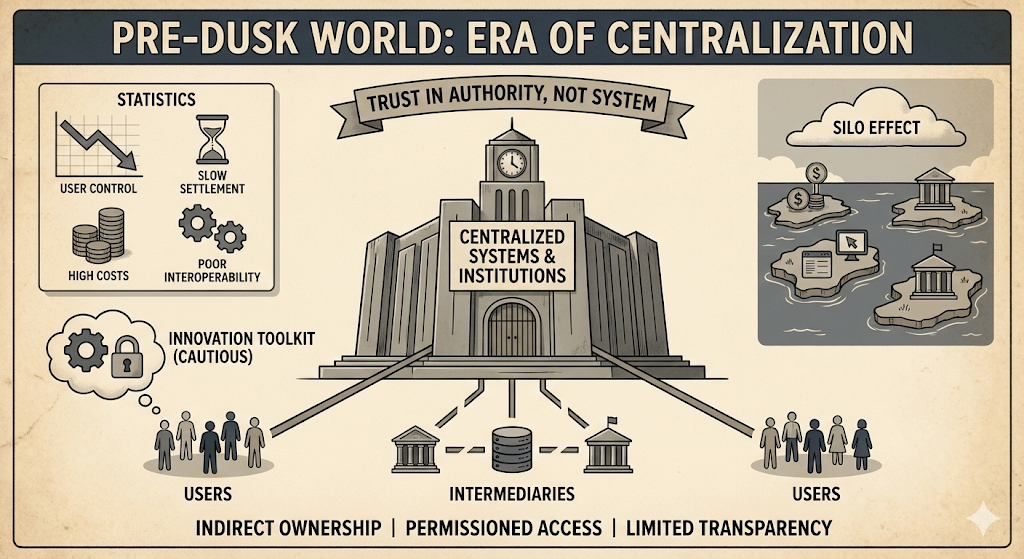
The pre-Dusk world represented a different model for constructing systems, criteria for making decisions, and establishing trust. During this phase of development, most systems were centralized and controlled by only a few groups. The majority of the systems created provided convenience over fairness to users. In finance, technology, and governance, end users relied heavily on intermediaries (ex: banks held assets, platforms stored data, institutions defined rules/regulations). Therefore, end users had limited access to both visibility and control over processes, which were typically sluggish & fragmented in nature.
Trust was founded on a brand or authority, not the system used. In addition, the architectural design in this era was also similar to that of the systems built in this time. Large, centralised buildings, data centres, and institutions served as the primary single point of control where if one point of control failed then everything dependant upon that point of control failed as well. The good news was there was a toolkit of innovation being used at that time; however, it was developing cautiously due to the constraints of bureaucracy and fear of change.
Statistics from this era convey an end user experience characterised by high costs, slow settlement times, and poor interoperability among systems. Each platform created its own island that had no means to communicate with the other platforms (the silo effect). Thus, from an end user viewpoint, this period was one marked by restrictions on how the customer behaved. Methods of ownership were indirect, and methods for acquiring access required permission. There was a promise of transparency but in virtually no instances was transparency provided on a real-time basis (ex: Digital systems improved; however, the core infrastructure supporting those digital systems remained unchanged), and therefore, end users were forced to change the way that they behaved in order to fit within the confines of the systems.
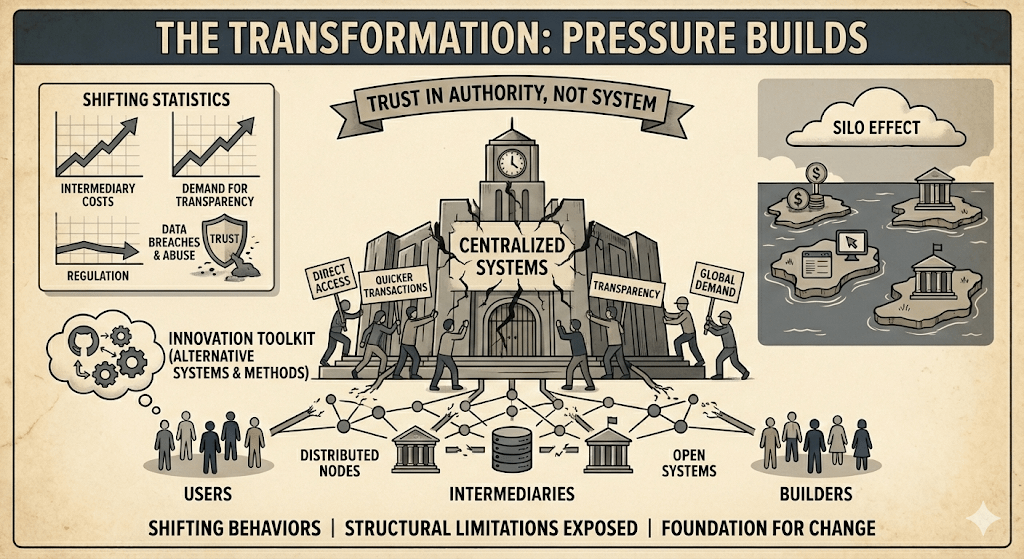
The transformation that occurred following the end of Dusk did not occur suddenly. A gradual buildup of pressure created by users, builders, and organizations, all of which recognized how weakly centralized designs can fulfill their needs. As the quantity of digital interactions grew, systems that were designed for small numbers of transactions began to struggle with global demand. Visibility of delays, outages, and lack of transparency became common. Data breaches and an abuse of power eroded the level of trust that users had in traditional systems. The figures from this period show rising costs of intermediaries and increasing demand for more rapid and transparent solutions to problems.
As this was occurring, user behaviors began to shift. People desired direct access to services, quicker confirmations of transactions, and well-defined protocols for financial, service, and product transactions. Users also expected systems to operate across geographies and all types of technical platforms. The inability of older designs to support these expectations exposed the limitations of their architecture. Demands for this evolution in architecture included changing from training the world to a single central point of failure into distributing each system across a number of nodes as well as changing from developing closed systems based solely on proprietary technology to developing open systems based on common technologies. Graphs developed during this period typically demonstrate very unevenly growing curves, with innovation outpacing governmental regulations and the infrastructure necessary to support them.
The importance of this period is that it sets the foundation for why the end of Dusk was created. It is not so much a function of popularity or hype but rather an acute awareness of what has become "structural" limitations in what formerly worked well. The existing business model cannot be scaled without diluting either trustworthiness or efficiency and as a result, development was exploring new patterns for doing business and institutions were researching alternative systems or methods.
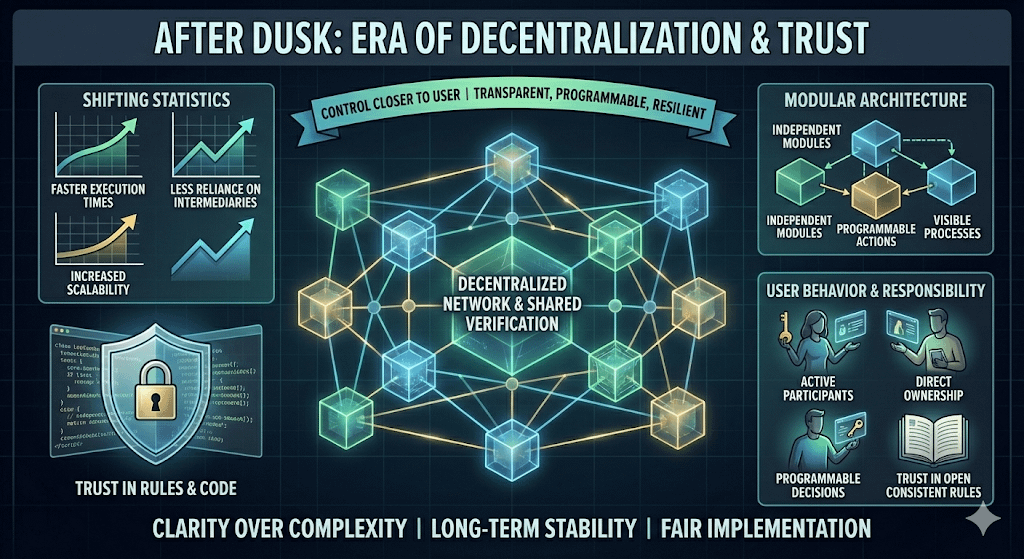
After Dusk indicates an explicit shift in the design of systems and how they treat trust. The control of the system has moved closer to the user. Systems are built to be transparent, programmable, and resilient. Instead of trusting one source of authority, there is a distribution of trust across rules, code, and shared verification. The architecture becomes modular. The network replaces the monolith. Each piece functions independently, but all pieces still work together as part of a larger whole.
From a design perspective, after Dusk is about clarity versus complexity. Processes are visible; actions are verifiable. Statistics from systems that were built during this phase show faster execution times, less reliance on intermediaries, and increased scalability. Graphs demonstrate a trending pattern of steady and sustainable growth rather than erratic spikes and collapses. This example demonstrates a focus on long-term stability.
The user's behaviour after Dusk also changes; users will become active participants instead of passive consumers. Ownership will be direct. Decisions will be programmable. Users will not rely on blindly trusting an institution. Instead, users will trust a written rule that is open and consistent. This does not remove the responsibility of the user; it will enhance it, as the user will have to understand how the system works and what effect their actions will have on the final result. After Dusk is not about eliminating rules, but about providing clarity and fairness in the implementation of the rules.
The technological and behavioral transformation resulting from Dusk will create better systems by promoting better habits through established principles of behavior. Transparency provides the foundation for confidence and minimizes the requirement for blind faith; automation reduces human error; and clear rules minimize disputes. Empirical evidence from environments that adopt these principles typically demonstrates enhanced operational efficiencies with reduced friction, as the length of time required to perform formerly lengthy tasks has significantly decreased.
Architectural flexibility underpins Dusk with architecture that is structured around flexible systems rather than fixed systems. Flexible systems allow for the modular nature of flexible systems because they can accommodate the creation of modular components that may be added to or removed from the overall system without impacting the overall integrity and functionality of the system. This principle of flexibility is true for both digital and physical metaphors (cities, networks, and platforms will emphasize movement and flow, as opposed to control).
The single greatest change that occurs for users is a change in philosophy. In Dusk, there is greater responsibility; however, there is also greater power and users will begin to take on more responsibilities with their assets, data, and decision-making. Education will be considered an integral part of the system, rather than an ancillary component. Dusk will foster the development of users’ ability to understand the overall environment and the components that comprise the environment, while minimizing users’ reliance on the particular attributes of a particular system. The process of changing the way in which users interact with their environment and the overall architecture of the environment is gradual, but it will create a much stronger foundation for the environment.
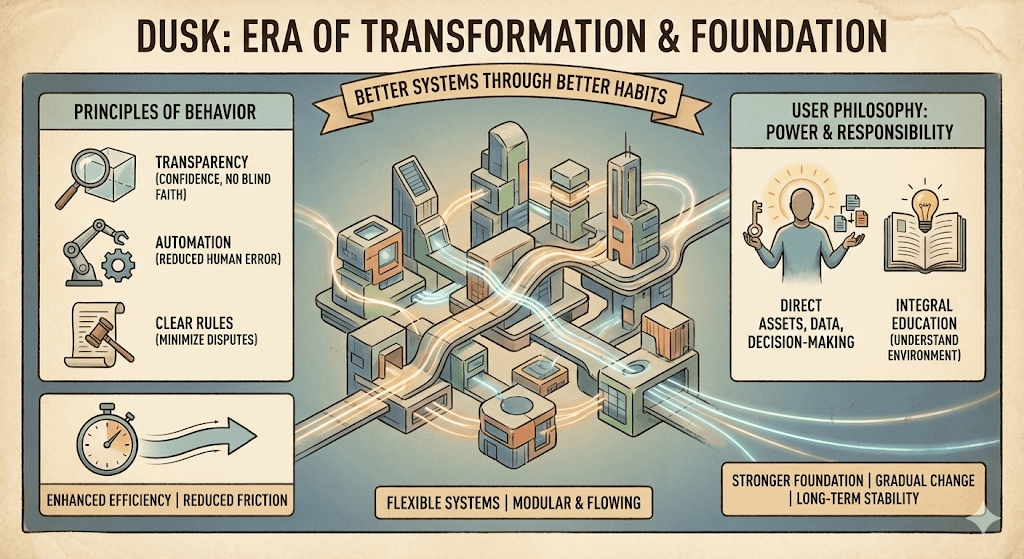
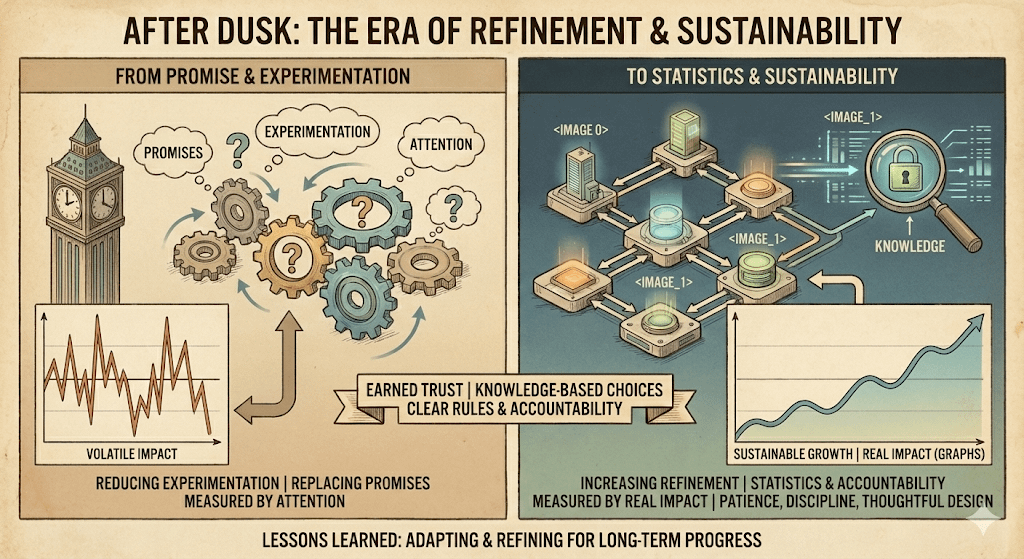
There is a clear distinction between before and after @Dusk in terms of how systems operated together as a set of control points with a degree of opacity, ranking and centralised authorities (Authority have always been at least some degree of authority). For example, before Dusk exhibited sharp spikes and downturn in terms of operational performance whereas after exhibited smoother, uniform pattern profiles in terms of operational performance. The structural configuration of before was vertical and structured whereas after is horizontal and flexible in nature.
The above is not an indication of how inappropriate past systems were in addressing the needs of their time. Rather, the evolution of technology has changed the usage of those technologies and the manner in which people expect to use them. After Dusk therefore, to the contrary, adopts new tools and subsequently to new thoughts because of the evolving nature of the user interface and increasing complexities brought about through design instead of control. Building long term relationships built upon trust is more favourable than building shorter term, more convenient, relationships.
In understanding the above, you can begin to see your own transformed view of your definition of Dusk and how this transition will continue over time. After is not a final destination for the transformation of systems. Rather, after is a new way to approach the transformation of systems. Systems will continue to develop, but basic principles (and increasingly important) of transparency, user empowerment and resilience will likely continue to remain at the centre of that evolution.