

If you’re looking at VANRY right now and wondering why it can trade like it’s alive while still feeling “small,” start with the basics: it’s been hanging around the $0.006–$0.008 zone lately, with roughly ~$10M-ish 24h volume and a mid-teens-$M market cap depending on the venue you’re checking. That combo usually means there’s real two-way flow, not just dead-holder drift.
The Underweighted Angle: Fee Design Changes User Behavior
The part I think a lot of traders are still underweight is that ’s “Fair Fee” idea isn’t just marketing. It’s a very specific fee design that changes how users behave, and that matters because user behavior is what eventually decides whether a gas token stays a ticker or becomes a sink for demand.
The Thesis (Trader-English): Kill Fee Uncertainty + Priority Games
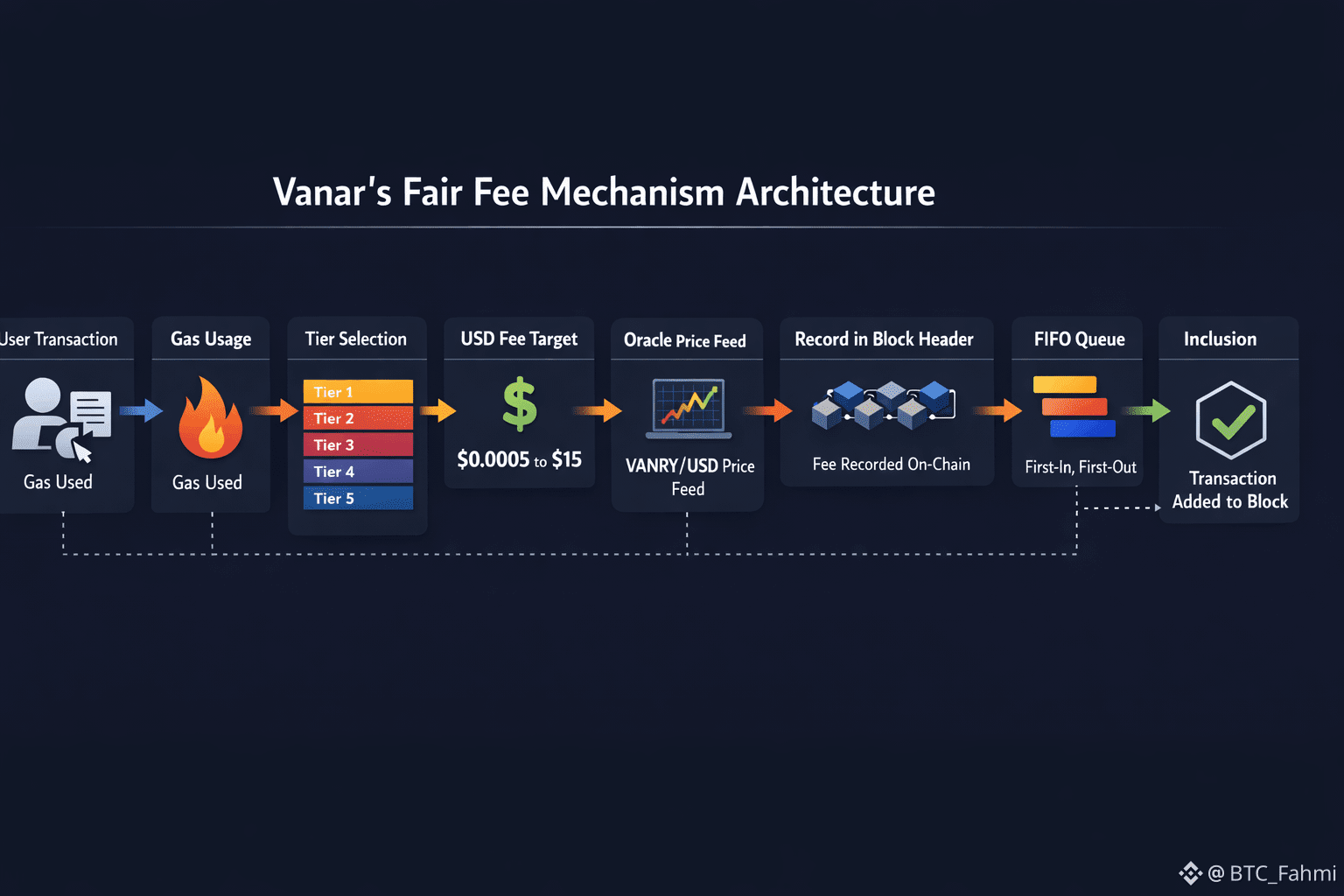
Here’s the thesis in plain trader terms: Vanar is trying to kill the worst part of onchain UX, which is fee uncertainty and priority games, by anchoring normal transaction fees to a fixed USD amount and processing transactions in order instead of “who paid more.” On their docs, the core claim is a fixed-fee model with a First-In-First-Out queue, so your transaction doesn’t become a bidding war the moment the network gets busy.
Key Mechanic: USD-Denominated Fees, Paid in VANRY
Now here’s the thing people miss: “fixed fees” doesn’t mean “one fee forever.” It means the fee target is denominated in dollars, then translated into VANRY based on a continuously updated price feed. Vanar’s architecture docs spell this out: they want the fee to stay consistent in fiat terms even if VANRY moves around.
Concretely, for the smallest, most common transactions, their tier-1 target is $0.0005. That’s not a typo. It’s half of one tenth of a cent.
Anti-Spam Reality Check: The 5-Tier Pricing Ladder
To avoid the obvious problem, which is “cool, so attackers can spam you for cheap,” Vanar adds a tier system. The docs lay out five tiers based on gas usage, with tier-1 covering 21,000 up to 12,000,000 gas at $0.0005, and then jumping hard for larger, block-hogging transactions up to $15 for 25,000,001–30,000,000 gas.
That’s the fairness piece that actually matters: regular users and normal dApp flows stay dirt cheap, while abusive, oversized transactions get priced like they’re consuming scarce block space, because they are.
Protocol Detail: Fee Recorded On-Chain + Multipliers Above Tier-1
Mechanically, Vanar says the protocol records a per-transaction fee value in the block header for tier-1 transactions, then uses a multiplier for higher tiers.
The Fragile Part: Price Feeds and Update Plumbing
The more delicate part is the price feed, because if you’re charging “$0.0005 worth of VANRY,” you need a VANRY/USD reference that can’t be easily gamed. Their docs describe a system that pulls price from multiple sources including DEXs, CEXs, and data providers like , , and , filters outliers, and then updates fees at the protocol level on a schedule. They also describe a fallback where if the protocol can’t fetch the latest fee data, it uses the last block’s values so blocks still produce and fees don’t go haywire.
Why Users Actually Care: Predictability Beats Narratives
So how does this benefit users in a way that actually shows up in usage? Predictability is the big one, and it’s bigger than it sounds.
Fixed, published tiers let teams budget, let apps subsidize fees with confidence, and let users press “confirm” without wondering if the fee will 10x before it lands. FIFO also removes the “I paid less so I’ll just get stuck forever” feeling, which is a quiet killer of retention. Users don’t obsess over decentralization narratives when the transaction fails three times. They just leave.
Token Implications: Tiny Fee Per Tx, Bigger Flywheel If Usage Sticks
Now connect that to VANRY, because that’s what you care about as a trader. The immediate effect of ultra-low fees is counterintuitive: per transaction, the amount of VANRY demanded is tiny. That means you don’t get a magical fee-driven value accrual story off small activity.
But you do get something more important for a network trying to grow: you remove the fee friction that suppresses experimentation. More experimentation means more apps. More apps means more transactions, more staking participation, more integrations, and more reasons for third parties to hold VANRY instead of renting it for a moment.
Supply Profile: Not an “Infinite Inflation” Setup, But Traction Must Prove It
The supply side is also fairly defined, with sources listing a max supply of 2.4B and circulating supply around the low 2.2B range. In other words, this isn’t a token where inflation can quietly erase your thesis overnight, but it also means the market will demand real traction before it pays up.
Bull Case: Scale + Heavier Workloads, Not “Fees Pump My Bag”
The bull case, realistically, is not “fees make VANRY explode.” It’s “fees make usage possible at scale, and usage pulls VANRY into more balance sheets.”
Put numbers on it: at 10 million tier-1 transactions a day, you’re only talking about ~$5,000/day in fees. That won’t move valuation by itself. But if the same environment also drives sticky users, higher-tier compute/storage-heavy transactions, and sustained staking demand, then you can start justifying higher floors because the token becomes operational inventory, not a speculative coupon.
Bear Case: Oracles, Congestion, and Spam Pressure
The bear case is straightforward.
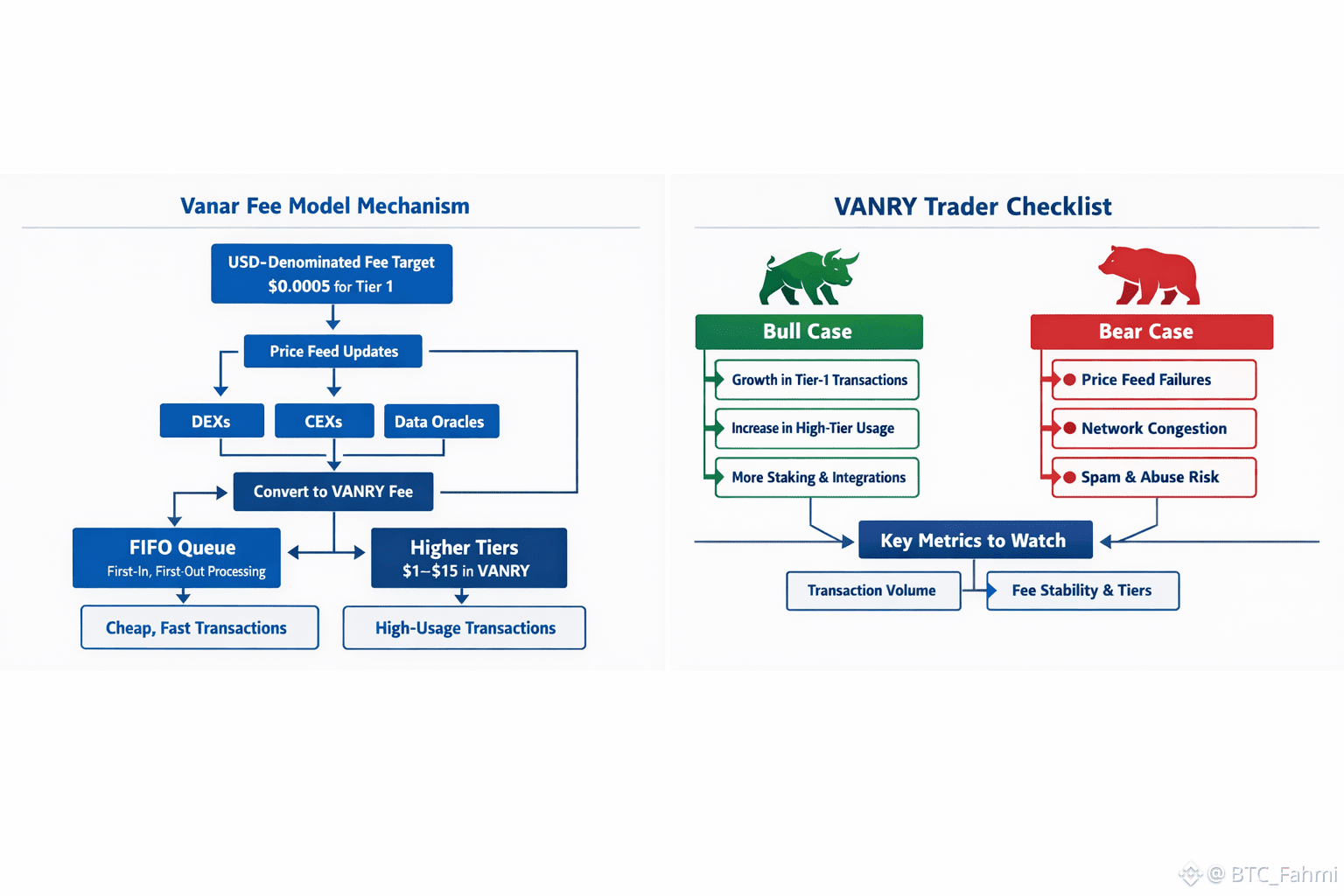
Price feed + fee updates add operational trust risk. Vanar’s docs explicitly put responsibility on the Foundation-side system that aggregates prices and pushes updates. If that system is attacked, misconfigured, or simply goes down more than expected, fee stability becomes a question mark.
FIFO doesn’t delete congestion. If demand exceeds capacity, you still queue, you just queue fairly. That’s fine until users decide waiting is worse than paying.
Ultra-low fees attract spam by default. The tiering has to work in practice, not just on paper. If attackers can still clog blocks cheaply using transactions that stay in low tiers, the market will punish it fast.
What I’m Watching: Tier Mix + “Boring” Reliability
So what am I watching to decide if this is working?
Transaction counts + unique active addresses, but specifically distribution across fee tiers.
If everything is tier-1 forever, it tells you usage is lightweight and you’re not yet capturing more complex workloads.
If you start seeing meaningful higher-tier activity without user complaints about cost, that’s healthier.
I’m also watching whether the fee update mechanism stays boring. No incidents, no weird fee spikes, no unexplained downtime. The moment “fixed fees” stops feeling fixed, the edge evaporates.
Bottom Line: Monetize With Scale and Fairness Or It’s Just Docs
Zooming out, this model is basically Vanar saying: instead of monetizing users with unpredictable costs, monetize them with scale and fairness. That’s a legit bet, and it’s aligned with how mainstream products win.
If you’re trading VANRY, the setup is simple. In the short run, price will do what micro caps do: it’ll whip around liquidity and narrative. In the medium run, the fair fee model either becomes a real reason people build and stay, or it becomes just another doc page.
I’m leaning toward “watch the boring metrics,” because if those start trending the right way, the chart usually catches up later.
