


Most regulators and market watchers focus on what happened in the market not when it became exploitable
They look at custody rules leverage limits and disclosures because those are easy to measure
But timing is also a risk surface and it is the part nobody talks about
In traditional finance timing risk was limited because orders were private
A trader would place an order through a broker and the market would not see the intent until after the trade was completed
The system was built around private routing delayed public reporting and controlled settlement
So the market did not know your plan before the trade finished
Blockchains changed this
On public chains intent becomes visible before finality
Once intent is visible the market stops being a place for price discovery and becomes a place for timing extraction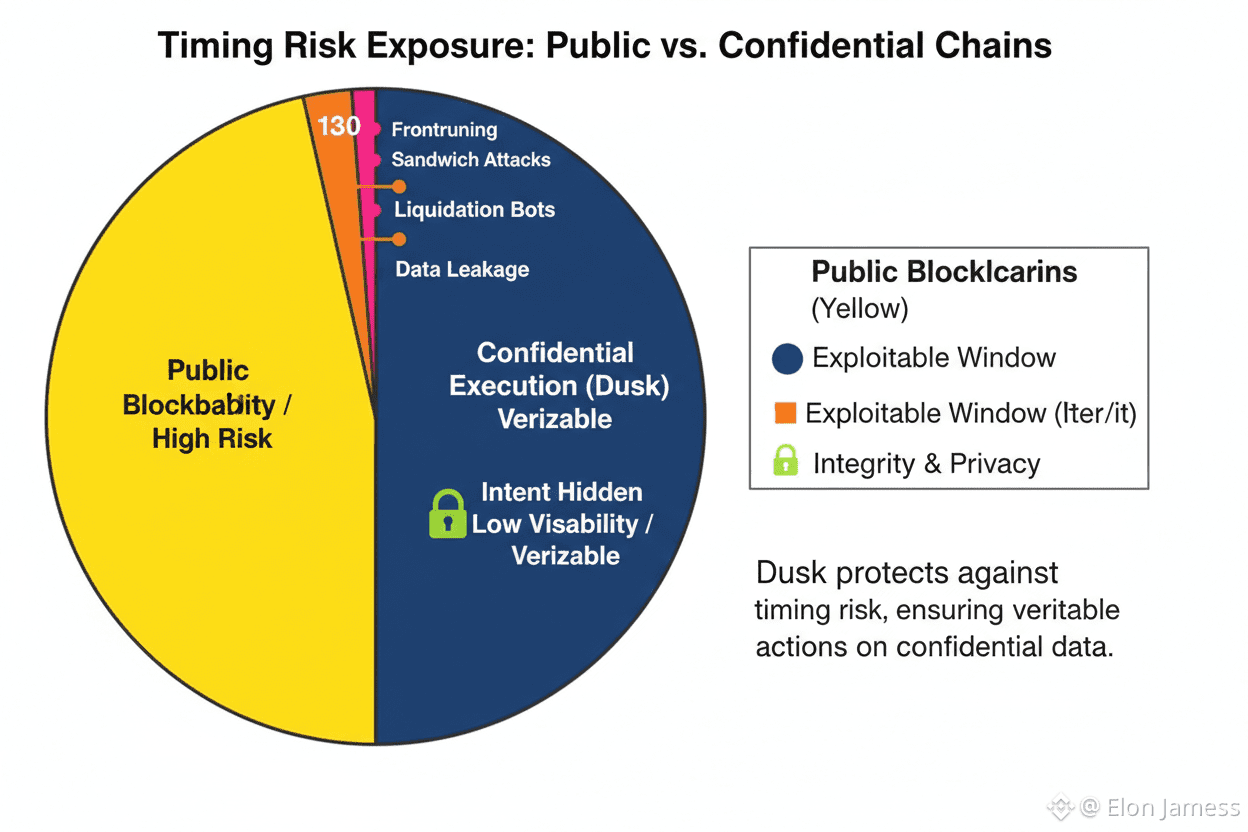
The moment an order is broadcast it creates a window where others can exploit it
Timing risk is the gap between intent and finality
Intent is when the order exists
Finality is when the trade is settled
On public blockchains there is often a measurable time interval between these two states
That interval is where predatory behavior thrives
Frontrunning sandwich attacks backrunning liquidation hunting and copy trade shadowing all live inside that window
Even if the chain has fast blocks the existence of a public pre settlement window still creates a market for prediction and exploitation
The shorter the window the less damage
But as long as the window exists publicly it can be monetized
Transparent execution creates a coordination failure
Honest traders want to act privately but the system forces them to act publicly
In institutional markets large trades are coordinated through mechanisms designed to reduce signaling
RFQs internal crossing dark pools brokered execution and delayed reporting regimes
These are not anti transparent
They are anti predatory
They protect execution quality
Public blockchains reverse this protection
They force everyone into the same public arena where intent is observable
That creates a structural coordination failure
Traders want to execute without signaling
Market makers want to quote without being gamed
Institutions want to deploy size without being tracked
But the chain makes intent visible anyway
So everyone adapts defensively
Splitting orders using intermediaries avoiding size and routing off chain
The market does not collapse
It just fails to mature
That is the silent cost of timing risk
Regulators rarely talk about timing risk because it looks like market efficiency on paper
If you only look at surface metrics transparent execution can appear healthy
High transaction volume active arbitrage constant price updates and rapid liquidation events
But those signals can hide something darker extraction driven activity
In a transparency first system the fastest actors are not providing liquidity
They are monetizing visibility
That changes the distribution of value
Users pay through worse execution
Liquidity becomes more cautious
Spreads widen for size
Institutions reduce participation
Retail gets taxed invisibly
This is not always illegal
It is simply structurally unfair
And fairness is what regulators care about even if they do not use that word yet
Execution windows turn compliance into a paradox
The system is auditable but the market is exploitable
Regulators want verifiable settlement audit trails and enforceable rules
Public blockchains deliver that
But they also create timing exposure where compliant participants get punished for being visible
So the paradox is the market becomes more transparent yet execution becomes less fair and large participants become less willing to engage
This is why transparency alone cannot be the endgame for regulated on chain finance
The next step is not less compliance it is better execution integrity
Dusk’s mitigation strategy starts with a simple principle
Execution should be verifiable without being predictable
Confidential execution changes the structure of the pre settlement window
Instead of broadcasting the full shape of a trade before it settles a confidentiality first system reduces the informational edge adversaries rely on
That directly attacks timing risk at its root visible intent
In practical terms confidential execution can reduce frontrunning opportunities limit sandwich setup visibility prevent liquidation stalking protect large order placement from signaling and preserve market maker inventory privacy
This is not about hiding markets
It is about preventing markets from becoming games of reaction speed
Coordination failures disappear when the market cannot exploit coordination itself
On transparent chains coordination becomes costly because coordinated actors become targets
If two institutions try to rebalance together the market can observe and front run the move
If a fund rotates from one RWA vault to another bots can mirror the trade and worsen execution
If a market maker adjusts inventory others can predict spreads
So the system punishes coordination even though coordination is what makes markets stable
Confidential execution reverses that incentive
Coordination becomes safer
Large flows become less disruptive
Liquidity becomes more willing
Price discovery becomes less manipulated
That is how markets mature
Not by exposing more but by reducing extractable timing edges
Why this matters for RWAs
Real assets cannot live inside a public execution window
Tokenized securities and RWAs introduce real world constraints
Eligibility restrictions regulated counterparties compliance driven settlement rules and reporting requirements
If their execution is exposed in real time you do not just create trading inefficiency you create operational risk
Investor registries become inferable
Issuers become targetable
Treasury actions become frontrun events
Counterparties become identifiable
RWAs do not fail on chain because the contracts are weak
They fail because execution visibility creates timing risk that regulated markets cannot tolerate
Dusk’s confidentiality first approach aligns with what RWAs need
Verifiable settlement without public exposure of intent
The most overlooked point
Timing risk is not just about profit extraction
It is about systemic stability
When markets become dominated by reactive actors
Volatility increases
Liquidity thins during stress
Liquidation cascades intensify
Spreads widen unpredictably
Trust erodes for serious participants
Regulators often respond to instability after it happens
Timing risk is a pre instability mechanism the structure that makes stress events worse
Confidential execution is therefore not merely a privacy feature
It is a stability tool
The future of regulated on chain markets will be built around execution integrity not just transparency
Transparency gave crypto credibility
Execution integrity will give crypto legitimacy
The chains that win institutional adoption will not be those that expose every action
They will be the ones that can prove compliance and settlement while protecting participants from timing based exploitation
Dusk’s positioning fits this evolution
Confidentiality reduces timing risk
Selective disclosure preserves compliance
Proof based verification maintains trust
Coordination becomes safer
Markets become fairer at scale
In modern markets the biggest risk is not what you trade
It is the time window where the market can trade you before your trade becomes final
