

@Vanarchain Inside Vanar, you learn quickly that “security” isn’t a banner you wave. It’s the feeling you get when you’re about to commit something you can’t take back: a file that proves ownership, a record that explains why money moved, a document that will be read by someone who doesn’t care about your intentions. In that moment, the chain stops being a concept and becomes a witness. That’s why the idea behind Neutron’s quantum-aware encoding lands differently here. It isn’t framed as an upgrade for bragging rights. It’s framed as a promise that what you store today won’t become fragile tomorrow, even if the world’s math changes underneath it.
Most people only notice security when it fails. They notice it as a spike of panic: a lost proof, a corrupted record, a link that no longer resolves, a dispute where both sides swear they’re right and neither can prove it cleanly. Vanar’s recent push around Neutron has been unusually direct about that pain. The project keeps returning to the same uncomfortable truth: if your “onchain” asset depends on an off-chain file staying available, you’re renting certainty, not owning it. Neutron’s purpose, as the team describes it publicly, is to take real files and transform them into small, verifiable objects that live inside the chain’s guarantees rather than beside them. 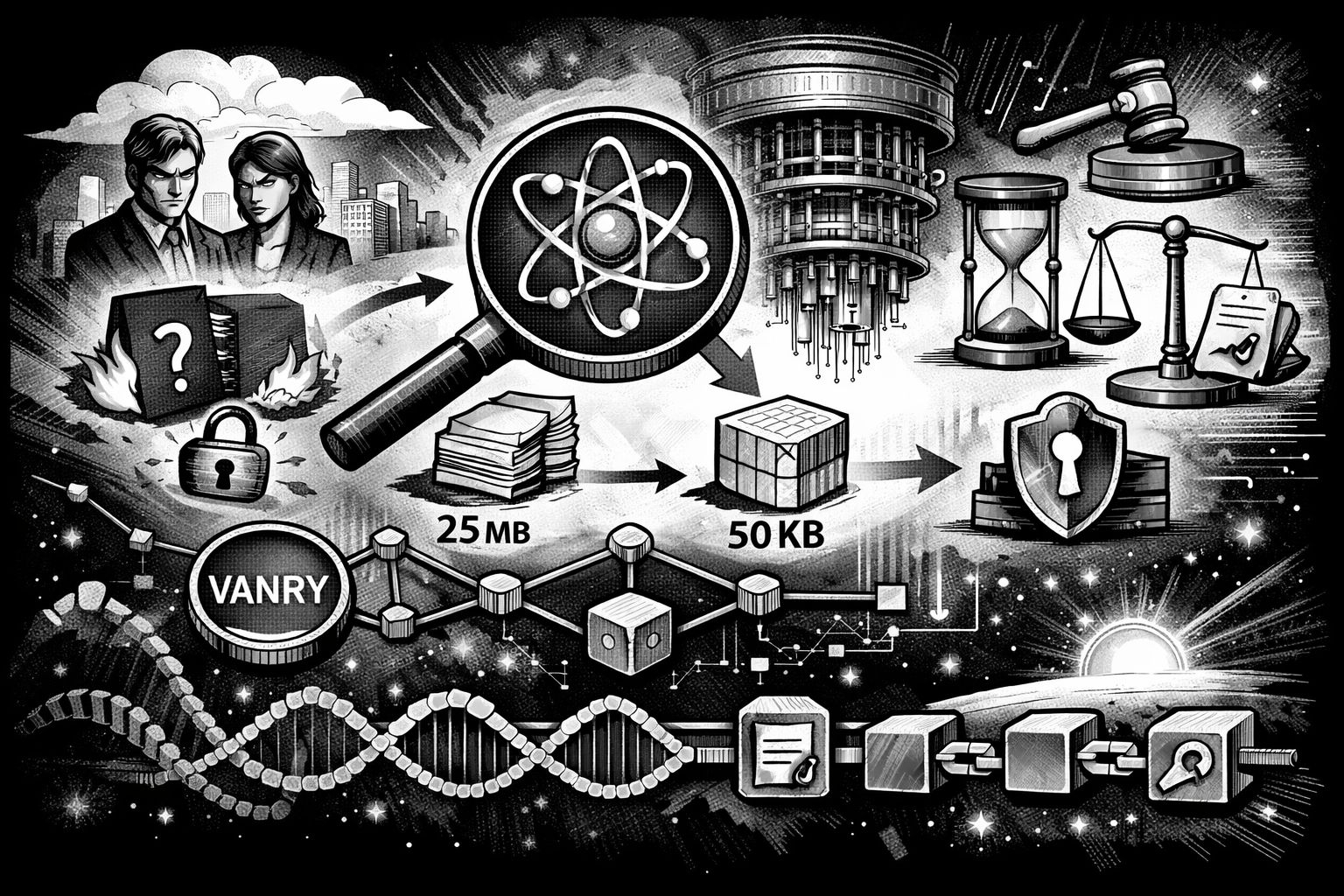
To understand why quantum-aware encoding matters in that flow, you have to follow how data actually breaks in real life. It rarely breaks because someone is evil in a movie-villain way. It breaks because systems are built around convenience and then stretched under stress. People upload a document once, assume it will stay reachable, and move on. Providers change terms, gateways rate-limit, teams rotate, and suddenly the “proof” becomes a scavenger hunt. Vanar’s Neutron narrative has leaned into a simple but heavy claim: if the chain is going to be the place where trust settles, the chain needs to carry more of the truth-bearing weight itself. That’s why they talk about compressing and restructuring files into something that can be stored directly and recovered deterministically, instead of leaving the most important part—content—outside the system.
Compression is the part that people quote because it’s easy to visualize, and the numbers are deliberately provocative. Vanar’s own Neutron material describes turning something like 25MB into about 50KB, and public write-ups repeat a “500-to-1” style claim from earlier coverage. Those figures aren’t just marketing flourishes; they’re an argument about feasibility. If you want onchain storage to be more than symbolic, the chain has to make large truth objects small enough to move through consensus without turning every block into a storage crisis. But compression alone doesn’t create emotional safety. It creates a new anxiety: if we squeeze reality this hard, do we still get reality back? So the deeper promise isn’t the ratio. It’s that the system can reconstruct what you put in, the same way, every time, even when the network is noisy and people are arguing.
This is where quantum-aware encoding fits as a kind of long-horizon discipline. In plain terms, it’s Vanar acknowledging that encryption choices are not neutral. They are bets about the future. Most teams treat that future as someone else’s problem because it doesn’t hurt today. Vanar’s recent Neutron messaging explicitly frames quantum-aware encoding as cryptographic work designed to remain resilient even if quantum computing advances to the point where some current assumptions weaken. Whether you think that day is close or far, the emotional logic is the same: if you are persuading people to place permanent records into an irreversible system, you don’t get to shrug at tomorrow’s threat models.
The subtle part is that “future-proofing” can become its own kind of dishonesty if it’s sold as certainty. 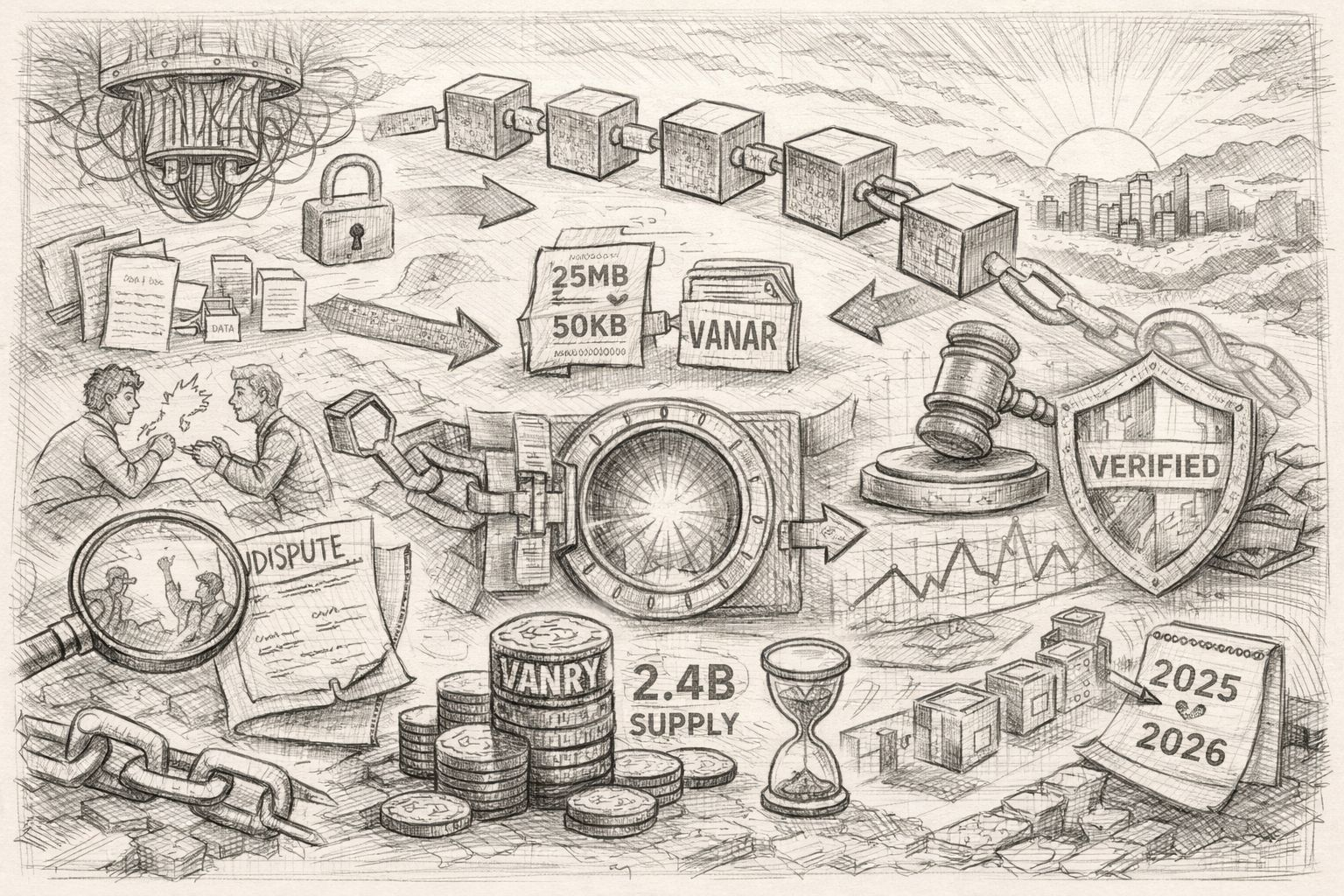
There isn’t a perfect seal that makes something safe from every new discovery. If you’re serious, you build so it can survive change: avoid choices that box you in, keep the system flexible so you can update your assumptions, and make sure a recovery doesn’t rely on one weak secret.Vanar’s framing of deterministic recovery—always producing identical output from the stored object—speaks to that mindset. It’s not saying “nothing will ever go wrong.” It’s saying that when things do go wrong, you should still be able to prove what was true without begging an external service to cooperate.
In practice, the “quantum-aware” conversation also changes how people inside the ecosystem talk about responsibility. Builders don’t just ask, “Does this work?” They start asking, “Will this still be fair if the world changes?” Fairness here isn’t philosophical; it’s operational. If an archive is only readable for the well-resourced, or if verification becomes a privilege because the cryptography aged badly, then the system quietly turns against the people it claimed to protect. That’s why this topic pairs so naturally with Vanar’s emphasis on turning documents into proofs that can be searched, validated, and carried inside the chain’s own logic. The point isn’t cleverness. The point is making sure the smallest participant can still stand on the same ground as the largest when disputes arise.
It also pulls token economics out of the abstract and into a more human frame. When Vanar talks about VANRY as the token required for paying network costs and participating in securing the system, it’s easy to read that as boilerplate. But inside a storage-and-proof narrative, it becomes more concrete: if people are going to anchor heavier truth objects onchain, someone has to bear the real cost of consensus, storage, and verification. The project’s own documentation emphasizes a capped maximum supply of 2.4 billion tokens and that additional issuance beyond genesis comes through block rewards. That structure is not just “tokenomics”; it’s the network deciding how it pays for honesty over time, and how it keeps the budget legible enough that participants can plan.
Markets, of course, will reduce that to price and circulating supply. Right now the public trackers show a max supply of 2.4B and a circulating supply a little over 2.25B, with total supply figures around 2.26B depending on the source and timing of updates. Those are not just trivia points; they shape the psychology of long-term users. A capped supply can create a sense that the rules won’t suddenly change when attention arrives. A high circulating percentage can also remove a certain fear—of invisible overhang—while still leaving room for people to argue about how rewards and incentives should evolve. You can feel the difference when builders talk: they spend less time guessing what’s hidden and more time debating what’s real.
Recent Vanar updates have tried to pull these threads together into a clearer timeline story: Neutron demonstrations in 2025, user-facing releases later in 2025, and a forward-looking posture in 2026 that leans hard into “real-world” utility rather than spectacle. Even allowing for the fact that some of the loudest summaries come from secondary channels, the through-line is consistent: Vanar wants the chain to be the place where data doesn’t just point outward, but becomes usable inside the system’s guarantees. And quantum-aware encoding is being positioned as one of the security chapters that makes that ambition less reckless.
Where this gets emotionally real is in the messy middle—when sources disagree. A company says a document is valid. A regulator says the language is insufficient. A counterparty claims the file was altered. A user insists they uploaded the right version. These are not edge cases; they are the daily texture of institutions and ordinary people alike. What Neutron is implicitly trying to do is shrink the space where ambiguity can hide. If the system can store a verifiable object that can be recovered identically, you reduce the number of “trust me” conversations. And when you layer in cryptographic thinking that anticipates a harder future, you’re admitting something most systems avoid: the argument isn’t only about what happened, it’s about whether we’ll still be able to prove what happened years from now, when the stakes are higher and memories are weaker.
The quiet risk, though, is that any system that makes proof easier can also make mistakes more permanent. If someone anchors the wrong file, or anchors a file that should never have been anchored, the chain won’t save them from their own haste.
Maturity isn’t having powerful tools. It’s having a culture that acts carefully: people review, verify, and slow down when speed is tempting. Incentives matter more than catchy words. Rewarding validators to be honest is one thing. Protecting users from mistakes they can’t take back is another. Good security feels like discipline. It gives you strength, but also guides you toward caution, because it knows you won’t always be calm and focused.
So “quantum-aware encoding” isn’t just future tech. It’s a way of saying: we take safety seriously.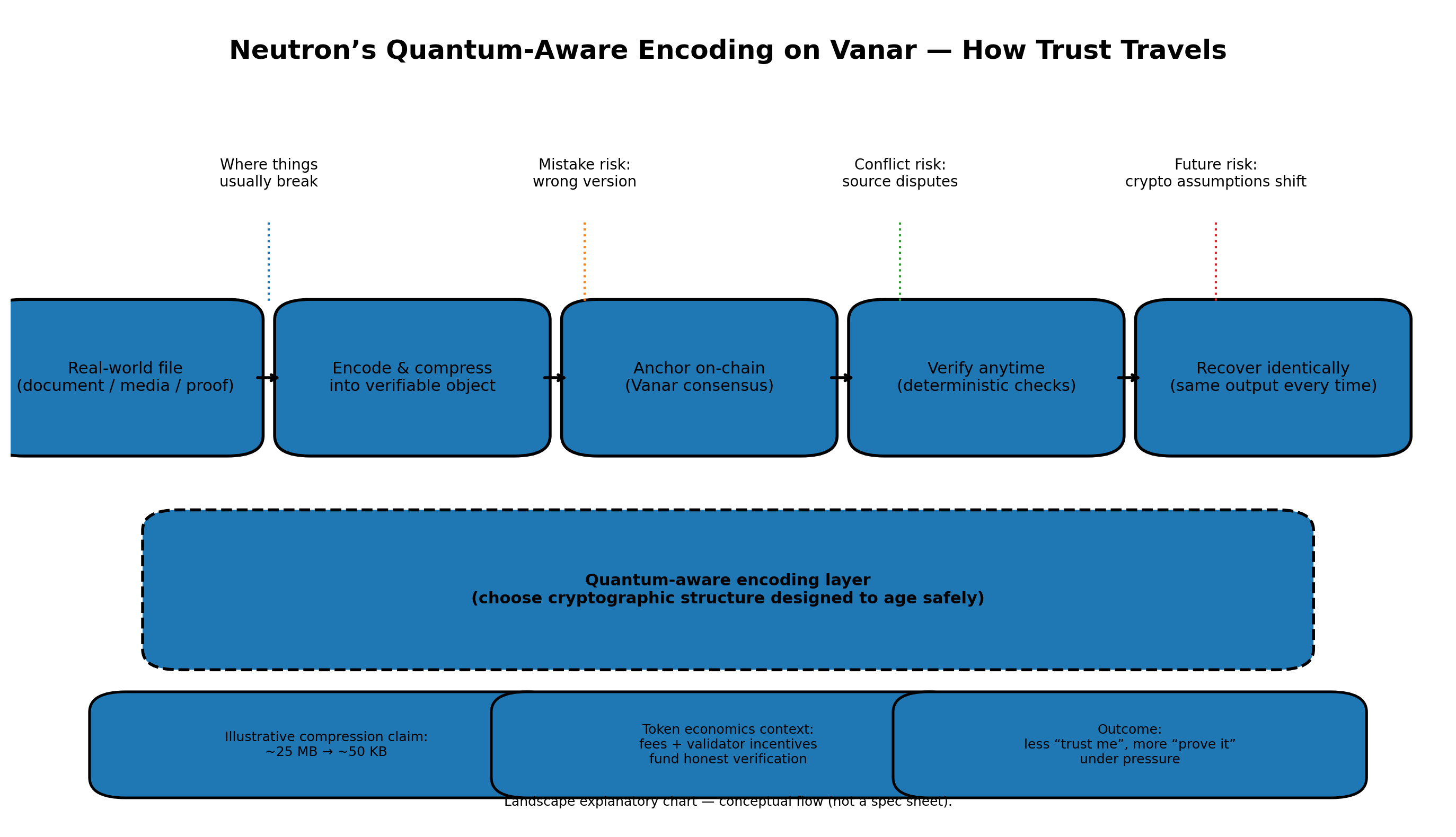
. It says: we are not only building for the calm days when throughput and optimism make everyone feel smart. We are building for the years when trust is expensive, when disputes are personal, when the easiest way out is to rewrite history, and when new computing power makes old shortcuts look irresponsible. Vanar’s insistence that files can become compact, verifiable objects onchain—and that the cryptography should anticipate tomorrow’s attackers—reads less like ambition and more like a refusal to leave future users holding the consequences.
And that’s the calm truth that sits underneath the token, the roadmap language, the compression numbers, and the security framing: reliability is an act of care. VANRY’s capped supply and reward design are, at their best, a way to keep the cost of honesty funded and transparent. Neutron’s approach to turning real files into recoverable onchain objects is, at its best, a way to reduce the humiliation of “we can’t prove it anymore.”
Quantum-aware encoding means preparing for changes that will come no matter what. In the end, the most valuable infrastructure is often invisible.It doesn’t beg for attention. It simply holds, quietly, when people need it most.
