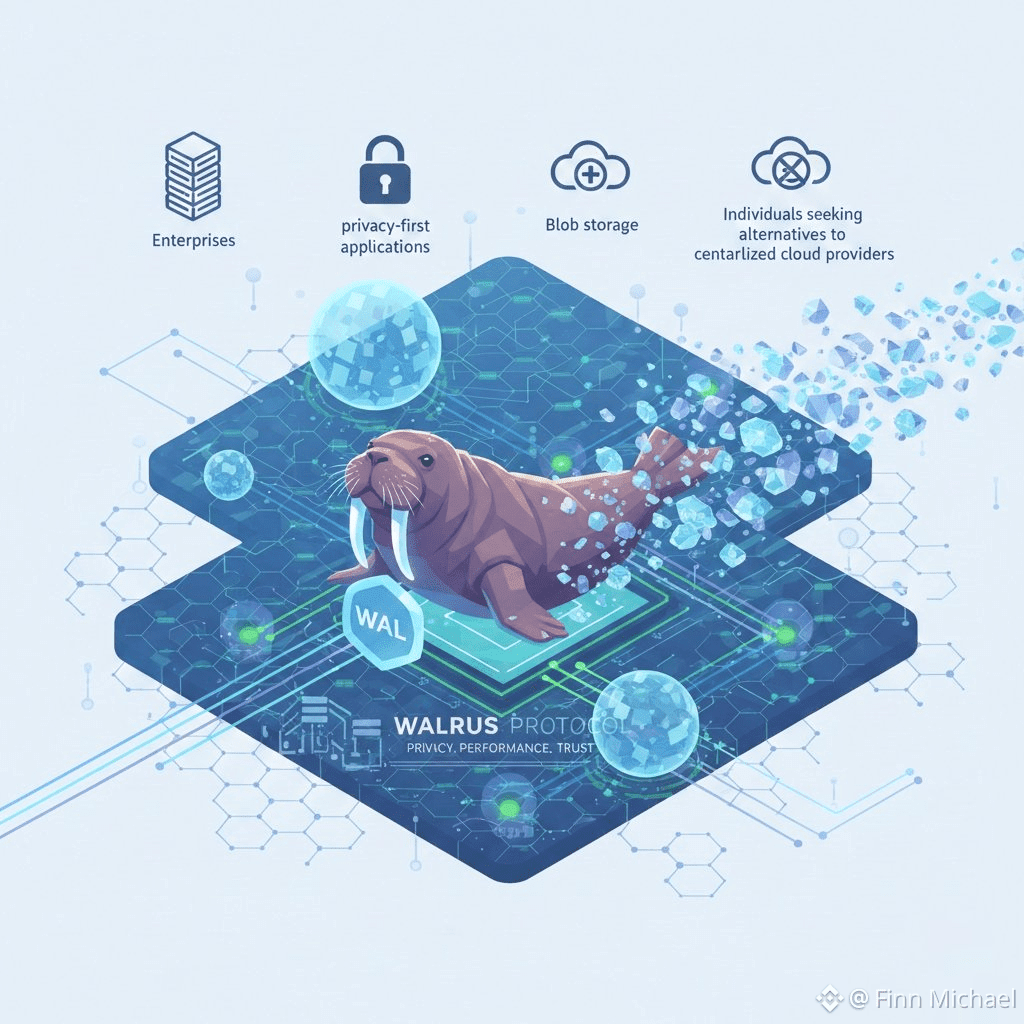
There is a moment every crypto believer remembers. The moment you realize blockchain is not just charts, tokens, or hype, but a quiet rebellion against systems that were never built for fairness. Walrus exists inside that moment.
At first glance, Walrus and its native token WAL look like another blockchain project in an already crowded space. But when you slow down and really understand what it is trying to solve, you begin to feel something deeper. This is not about faster transactions or temporary gains. This is about ownership in a world that has slowly taken it away from us.
Blockchain technology was born from a simple but powerful idea: trust should not depend on institutions. Walrus carries that idea forward into one of the most sensitive areas of the digital world—data and value. Built on the Sui blockchain, Walrus uses decentralized infrastructure to give people control over how their data is stored, accessed, and protected, without relying on centralized authorities that can change rules overnight.
WAL, the native cryptocurrency of the Walrus protocol, is not just a token that moves between wallets. It is the fuel that keeps the system alive. Every action inside Walrus—storing data, maintaining availability, securing the network, participating in governance—flows through WAL. This makes the token meaningful, not decorative. It connects value directly to contribution, something traditional systems have failed to do.
What makes Walrus feel human is how it treats data. Instead of locking files inside a single server owned by a company, Walrus breaks data into coded pieces and spreads them across a decentralized network. This means no single entity controls it. No single failure destroys it. Even if parts of the network disappear, the data survives. That resilience mirrors something deeply human: the instinct to preserve what matters, even when conditions are uncertain.
The Sui blockchain plays a critical role here. It brings speed, efficiency, and structure to Walrus without sacrificing decentralization. Through Sui, every stored file becomes verifiable on-chain, while the actual data remains private and secure off-chain. This balance is where blockchain stops being abstract technology and starts feeling like protection.
WAL also represents voice. Token holders are not just spectators. They are participants in governance, shaping decisions that guide the future of the protocol. This transforms users into stakeholders, and stakeholders into builders of a shared system. In a world where people often feel powerless against big platforms, this sense of agency matters more than most realize.
There is an emotional truth behind why projects like Walrus resonate. People are tired of building value for systems that do not serve them back. They are tired of creating content, data, and digital assets only to lose control over how they are used or monetized. Walrus offers a different relationship—one where technology serves people, not the other way around.
From a blockchain perspective, Walrus shows how decentralized finance and decentralized storage can work together. WAL is not separated from the utility of the network. Its value grows with real usage, real demand, and real contribution. This is the kind of crypto design that survives cycles, because it is rooted in function, not speculation.
As blockchain technology matures, the market will slowly move away from empty promises and toward protocols that quietly do the hard work. Walrus feels like one of those protocols. It is not loud. It is not chasing attention. It is building infrastructure that can last.
In the end, Walrus and WAL represent something bigger than a token or a protocol. They represent a shift in mindset. A belief that digital ownership should be real. That privacy should be respected. That value should be earned and shared, not extracted.
Blockchain was always meant to be about freedom. Walrus reminds us of that truth—not with noise, but with intention.