
When I first took a look at Dusk, I was surprised not at one singular revolutionary thing, but more at the sheer magnitude of responsibility that was apparent in the system as a whole. Most block-chains try to achieve both privacy and compliance, while sacrificing one to achieve the other. Dusk handles the regulation, operational reliability, and confidentiality consideration as a problem that could be solved through intentional design. For me, the question isn’t about what Dusk presents, but how it acts under the magnifying glass.
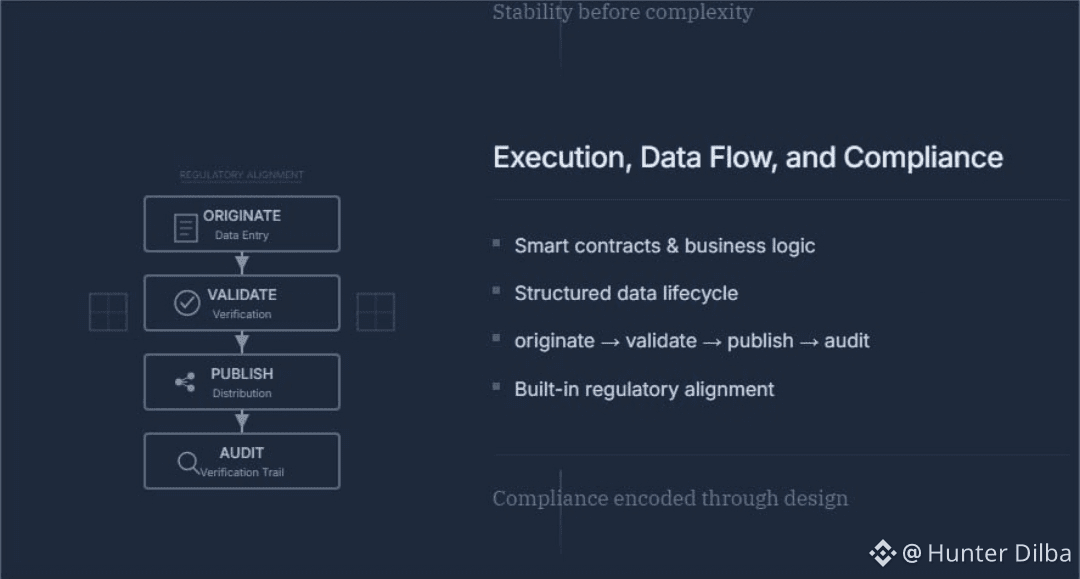
The other thing that I immediately noticed was the foundational design. Dusk splits the settlement and data available layers from the execution and business logic layers. This distinction might seem subtle, but it is crucial in terms of institutional impact. In regulated finance, real danger is not greater throughput, it is systemic complexity. Networks grow in state and complexity, hardware requirements grow, and the centralization of the network becomes unavoidable. As the number of operators able to support the network grows smaller and smaller, the overall fragility of the system increases, which is the result that institutions want to avoid the most. Dusk's conservative approach to design at the core of the infrastructure allows more complex systems to be developed at the surface without risking the core system. This isn’t eye catching, but it’s how solid infrastructure is formed.
Data management is an area where Dusk uniquely resembles blockchain practice. In established markets, ownership, validation, and standardization of data are critical. Dusk mirrors this by treating data as a primary tool for meeting requirements, rather than an afterthought. It understands where data comes from, how it proliferates, who confirms it, and how it is retrievable for years. While observing the mechanisms of interoperability and the flow of information, I see a system attempting to balance the logic of the institutional market and the mechanics of blockchain. The constrained resource is not developers or liquidity, but such designers who can transcend the regulatory, operational, and technical domains.
There is also a subtlety in how privacy is also managed. Dusk does not view confidentiality as a binary, all-or-nothing proposition. It is also a value that can be layered, where its attributes can be stratified, and in some cases, be operationally defined. Applications and users may choose from different models of transactions based on risk, compliance, and operational factors. Privacy is a continuum rather than a switch. In my view, this is not a compromise; it is how advanced financial systems function. Certain data has to be public, certain data has to be private, and some has to be made available in a controlled manner. Dusk’s design retains the operational framework of the institutions without compromise.
For Dusk, operational honesty is commendable. Issues such as roll-up finality trade-offs, node software updates, and migration boundaries are taken as given. Trust in transition is addressed unambiguously as off-chain listeners, memos, and transitional asset states are visible and managed rather than hidden. Being frank is, for Dusk, highly valued. Systems that conceal these elements are likely to fail when examined closely, even if they seem polished on the surface.
Dusk also treats settlement with the corresponding institutional seriousness. The base layer is sacred, like a clearinghouse, central securities depositories, or a payment rail. Here, reliability is the name of the game, and the higher layers are allowed to evolve more quickly. This hierarchy is how Dusk designs for operational trust rather than adoption velocity or the narrative — a crucial but often overlooked distinction in a highly regulated environment.
Dusk also communicates risk with intention. Inadequate bridges, buggy smart contracts, and a host of other friction introducing options do not disappear as a function of compliance. What matters is that these risks are unambiguously communicated.To me, Dusk's credibility relies both on the framework of the system as well as the honest admission of shortcomings. This system demonstrates how trust is built. It is built through consistent behavior, not through marketing or advertising hype.
Without any critique, Other chains focused on throughput, total value locked, or user growth. Dusk optimizes for deterministic execution, controlled disclosure, and defensible audit. It’s clear to me Dusk is not competing with consumer focused chains. It’s positioned itself in the realm of internal ledgers, permissioned networks, and legacy settlement systems. It’s Dusk's design that takes the position that visibility is a liability, mistakes are expensive, and that accountability must be built into the system, not just added as a policy.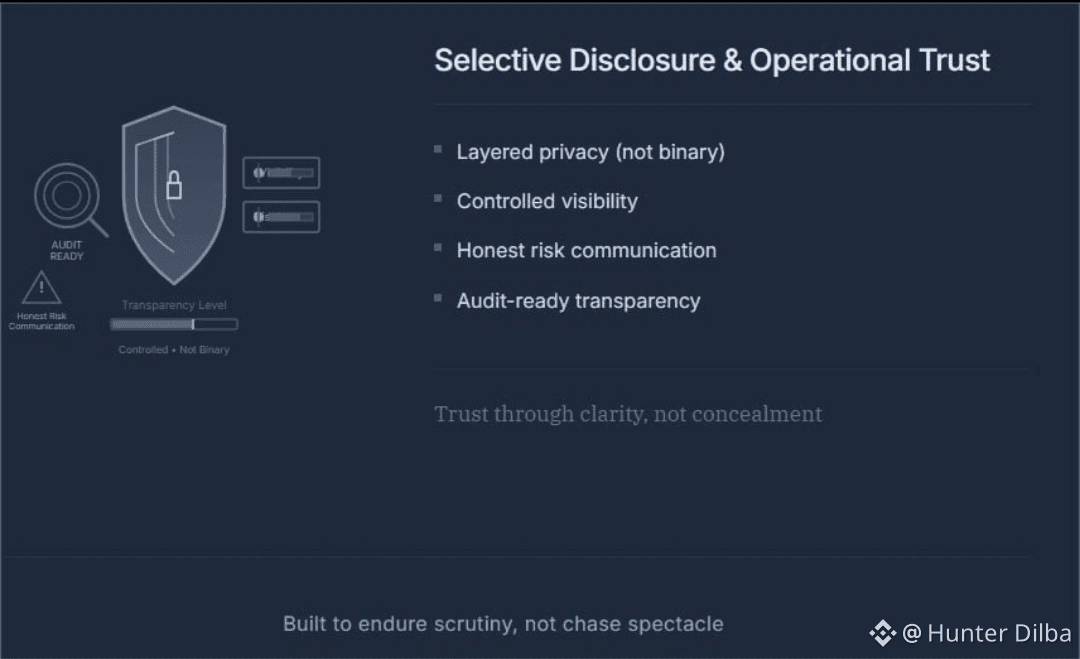
The same system parameters and design policies are reflected in the tokenomics. The planned emissions, validator-centric staking, and liquidity controlled design for participation are also intentional. It’s clear to me this is a chain that is meant to endure. Everything about it’s operational and economic model is planned for sustained credibility as opposed to short term narratives.
As we step back, the evolving picture reveals dusk is developing from an experimental privacy chain into something able to handle the infrastructure of regulated financial transactions. Its growth is deliberate, measured, and steady; it might not ever be a headliner, but the advantage is structural: embedded trust and predictability along with a durable build. With Dusk, I am reminded of a principle in blockchain that is often overlooked: the progress of regulated finance is persistent, deliberate, and quiet.
Dusk is the evolving example of how privacy, compliance, and architecture can merge seamlessly to show that on chain finance, even with the constraints of regulation, is possible. For the most part, it is not the most inspiring, but it is a defining system that respects all the constraints of a set system, all the while communicating and behaving as a system should in a period of calm. In regulated finance, that is meant to say it is the period of most sound finance.
