
Most EVM-compatible networks promise developer adoption, composability, and DeFi integration. But few consider regulated finance realities: auditability, selective privacy, and institutional risk tolerance. Dusk solves this problem directly through the synergy between DuskEVM and Hedger, turning theoretical compliance into operational infrastructure.
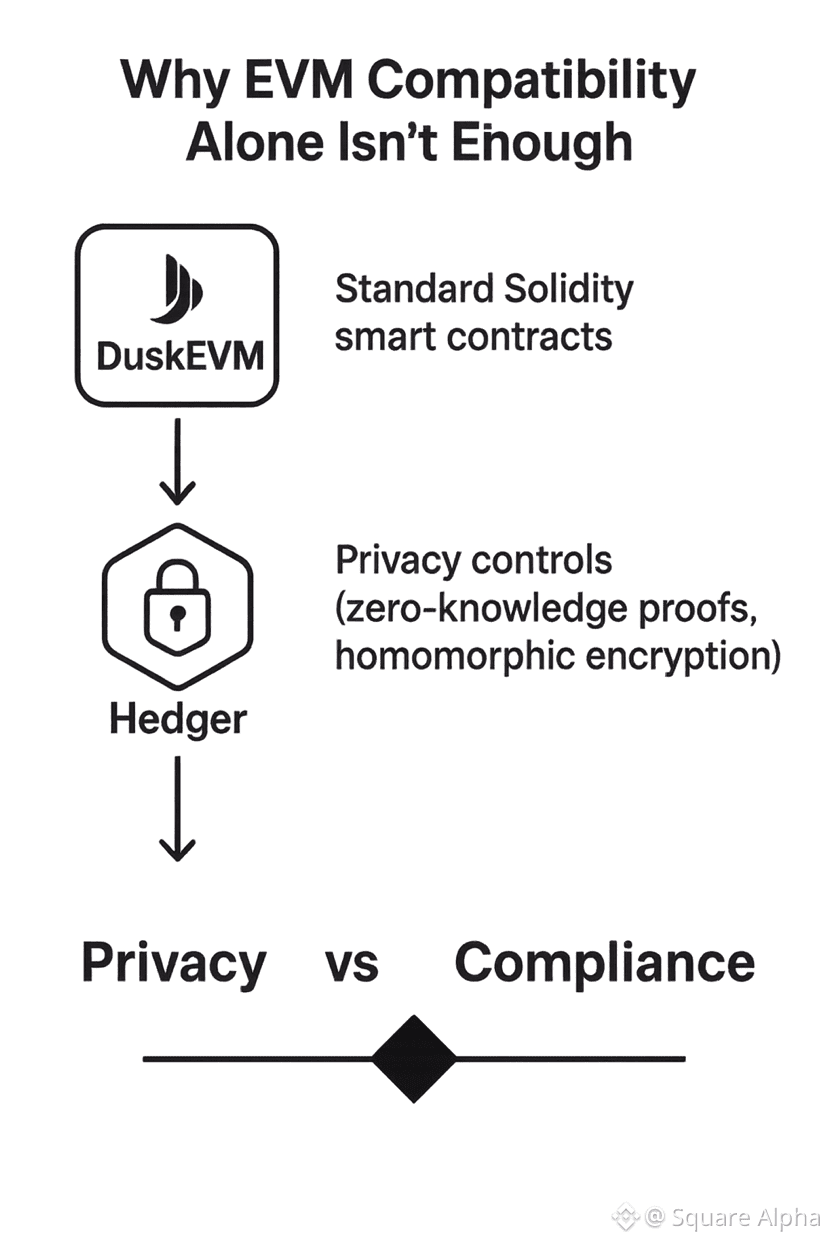
Why EVM Compatibility Alone Isn’t Enough
DuskEVM allows developers to deploy standard Solidity smart contracts, reducing friction for institutions used to Ethereum tooling. But without privacy controls, sensitive transactions — think securities transfers, dividend settlements, or investor balances — would be exposed on-chain.
Hedger closes that gap. By integrating zero-knowledge proofs and homomorphic encryption, it ensures transactions can remain confidential without compromising auditability. This means regulators can verify compliance while institutions retain operational privacy.
This combination is rare: most chains either prioritize privacy (at the cost of regulatory clarity) or compliance (at the cost of user confidentiality). Dusk bridges the divide.
Practical Implications for DuskTrade
With DuskTrade launching in 2026 and €300M+ in tokenized securities coming on-chain, DuskEVM + Hedger ensures that real-world asset operations can occur seamlessly:
Confidential Settlements — Sensitive trades remain hidden from public observers but verifiable by authorized auditors.
Compliant DeFi Integrations — Protocols can interact with regulated tokens without exposure risk.
Predictable Scaling — Hedger’s cryptography is optimized for Layer 1 settlement, so confidential transactions don’t create unpredictable bottlenecks.
In short, developers and institutions can build real financial products, not just experiments, while staying fully compliant.
Economic and Token-Level Impact
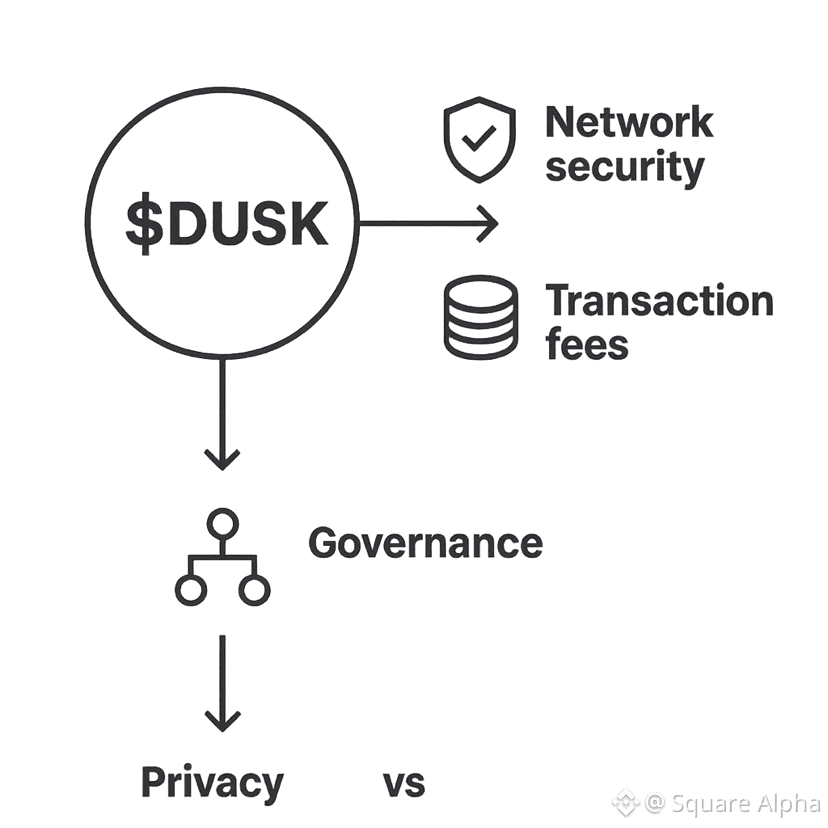
$DUSK is embedded into every layer of this system:
Network security: validators stake DUSK to secure confidential transactions.
Transaction fees: all DuskEVM operations require DUSK, creating usage-driven demand.
Governance: protocol upgrades and Hedger refinements are coordinated via DUSK voting.
As adoption of DuskTrade increases and new DeFi applications integrate with DuskEVM, DUSK moves from speculative token to utility anchored in real financial activity.
Strategic Advantage
Most EVM chains rely on external privacy layers or third-party audit solutions. Dusk’s native integration reduces operational risk and developer overhead. Institutions don’t need to juggle multiple tools or trust intermediaries — everything is built into the protocol.
This gives Dusk a long-term advantage:
Lower friction for onboarding regulated participants
Minimized attack surface for confidential operations
Built-in compliance that scales with usage
Conclusion: Infrastructure for Real-World Finance
The combination of DuskEVM and Hedger isn’t just a feature set; it’s a strategic enabler for institutional-grade blockchain finance. By focusing on developer familiarity, privacy, and compliance, Dusk creates a foundation for regulated DeFi, tokenized securities, and real-world asset operations.
Other chains chase throughput, hype, or novelty. Dusk builds infrastructure that works when it really matters: in live financial markets under regulatory scrutiny.
This is why Dusk is worth watching — not as a quick bet, but as a network designed for execution, resilience, and real-world adoption.
