
@Walrus 🦭/acc is not just another storage protocol. It is a foundational layer for data-driven Web3 applications — and its design philosophy reflects a rare clarity: in decentralized networks, data is state, not a file. That subtle distinction drives everything Walrus does and explains why $WAL is more than a token: it is the economic instrument that enforces reliability.
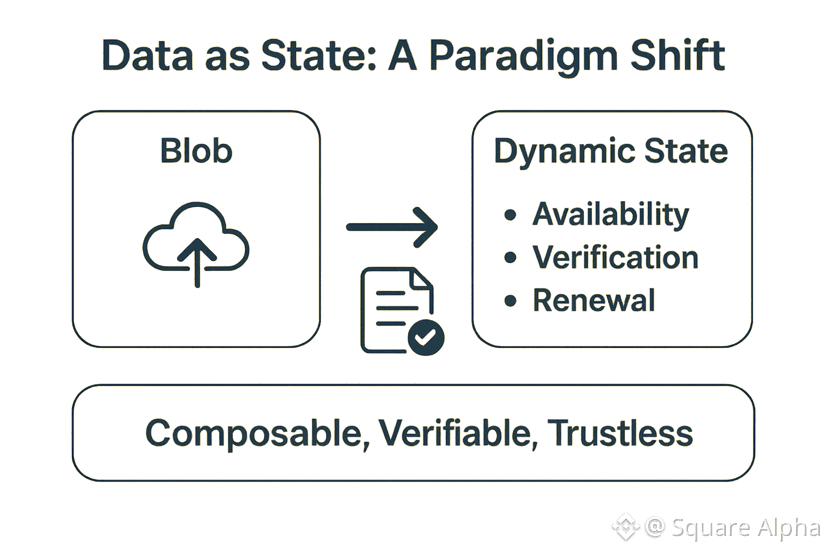
Data as State: A Paradigm Shift
Most decentralized storage solutions still operate in Web2 terms: a blob is uploaded, replicated, and hoped to persist. In real-world networks, this assumption fails constantly. Nodes go offline, usage spikes, incentives drift, and applications evolve. Walrus treats data as dynamic state, bound by rules for availability, verification, and renewal.
On Sui, this is critical: the network is object-centric. Every blob can carry logic about its lifecycle and responsibilities. By embedding custody into the protocol, Walrus allows developers to treat storage as a predictable, verifiable resource, not an afterthought.
This approach fundamentally changes how developers build:
NFT marketplaces can guarantee media integrity without relying on fragile CDNs.
AI agents can trust dataset availability when training or inference occurs.
DeFi protocols and RWAs can securely reference historical proofs without off-chain dependencies.
Data becomes programmable state, enabling composable, verifiable, and trustless operations at scale.
Churn-First Design: Preparing for Real-World Stress
Most storage networks optimize for calm conditions, where replication appears sufficient. Walrus optimizes for stress. By assuming node churn is inevitable, the protocol designs recovery and redundancy to work under extreme conditions.
The RedStuff erasure coding mechanism is central here. Files are split into fragments that are distributed across nodes, allowing recovery with minimal overhead even if multiple nodes fail simultaneously. Recovery bandwidth scales with actual loss, not total blob size. This design ensures:
Predictable availability under network fluctuations
Cost efficiency compared to brute-force replication
Operational reliability for high-value applications
In effect, Walrus does not “store files.” It enforces their continued existence as a protocol-level guarantee.
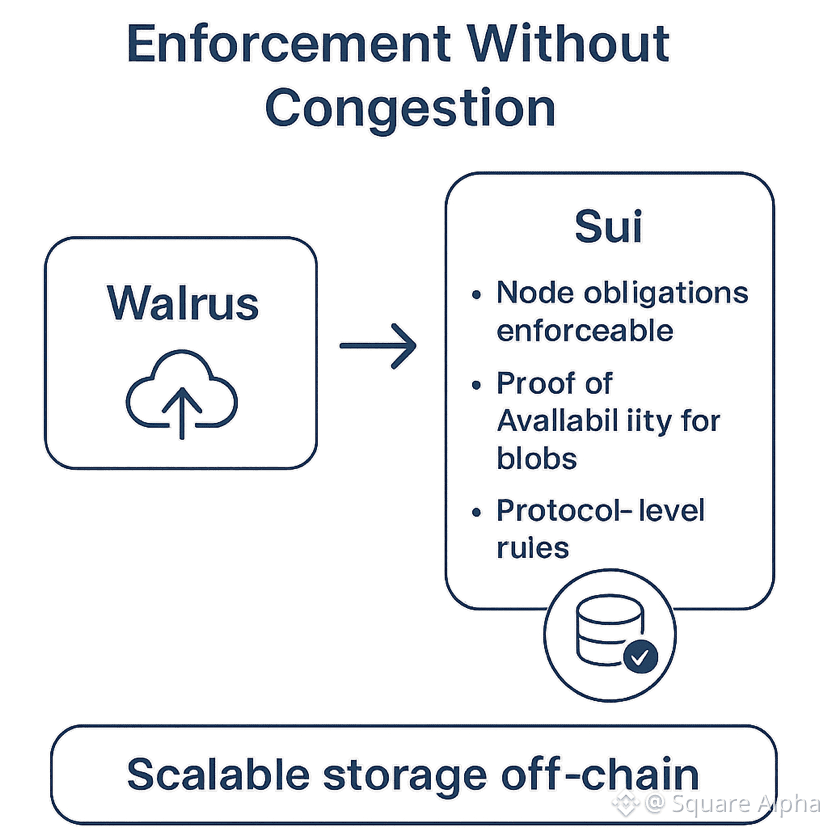
Sui Integration: Enforcement Without Congestion
Walrus separates control from storage. Actual blobs live off-chain, but Sui manages custody logic, proofs, and accountability. This means:
Node obligations are enforceable via on-chain logic.
Blob availability can be continuously verified with Proof of Availability certificates.
Protocol-level rules reduce reliance on centralized coordination.
This separation allows scalable storage without bloating Sui’s base layer, while maintaining cryptographic, auditable guarantees.
WAL: Aligning Economics With Persistence
$WAL is not speculative; it is operational. The token’s utility aligns incentives across the network:
Stakers are rewarded for maintaining uptime and following custody rules.
Developers pay in WAL to access verifiable storage.
Governance participants ensure the protocol evolves with demand.
This creates a self-reinforcing economic ecosystem: persistent usage drives token demand, which secures data, which further encourages adoption.
Implications for Web3 Infrastructure
The real-world impact is profound:
AI-driven applications require datasets that can be verified and reused autonomously. Walrus enables this.
Persistent virtual worlds and games can survive node churn without losing critical state.
Tokenized real-world assets gain long-term auditability and compliance guarantees.
In other words, Walrus is infrastructure for applications that cannot tolerate data failure — the kind of infrastructure that underpins real economic value in Web3.
Final Take: Why Walrus Matters
Decentralized storage is not about “cheap space.” It is about operational certainty. Walrus achieves this by:
Treating data as active, programmable state
Designing for churn, not calm
Leveraging Sui for enforcement
Aligning incentives through WAL
For developers, Walrus offers a predictable foundation. For investors, WAL is tied to usage, not hype. For Web3, Walrus is a necessary layer for scaling data-driven, resilient applications.
In short, Walrus does not promise that files exist. It guarantees it, and that guarantee is increasingly valuable as Web3 grows in complexity and scale.


