
Most blockchains talk about AI. Very few are actually built for it.
That distinction matters more than ever.
As autonomous agents, on-chain reasoning systems, and machine-driven workflows move from theory to production, the industry is learning a hard truth: AI cannot be retrofitted into legacy infrastructure. Chains designed for human wallets, manual transactions, and narrative-driven usage will struggle. Infrastructure designed from day one for intelligence will dominate.
This is where @Vanarchain and $VANRY enter the picture — not as a trend, but as exposure to AI-native readiness. #vanar
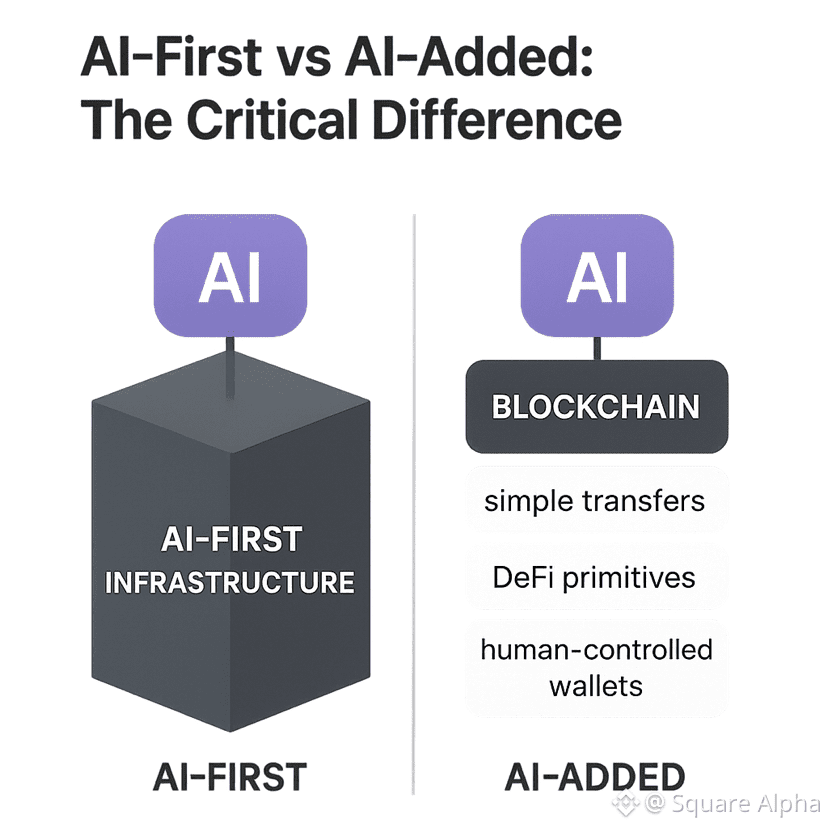
AI-First vs AI-Added: The Critical Difference
Most “AI blockchains” today are AI-added.
They bolt AI features on top of systems originally built for:
simple transfers
DeFi primitives
human-controlled wallets
That approach breaks down quickly. AI systems don’t think in transactions. They think in context, memory, inference, and automation.
Vanar takes the opposite route. Its infrastructure is AI-first, meaning intelligence is assumed at the base layer — not layered on later as a marketing feature.
This is why VANRY aligns with native intelligence, not AI narratives. The chain wasn’t redesigned to host AI. It was built to be used by AI.
What “AI-Ready” Actually Means (And Why TPS Is Irrelevant)
The industry still obsesses over TPS. That metric is outdated.
AI-ready infrastructure requires entirely different primitives:
Persistent semantic memory
Reasoning and explainability
Autonomous execution
Deterministic settlement
Speed without intelligence is noise.
Vanar’s architecture supports these requirements directly. Instead of asking, “How fast can transactions settle?” the real question becomes:
Can intelligent systems remember, reason, act, and settle value without human intervention?
That’s the bar — and it’s where VANRY derives long-term relevance.
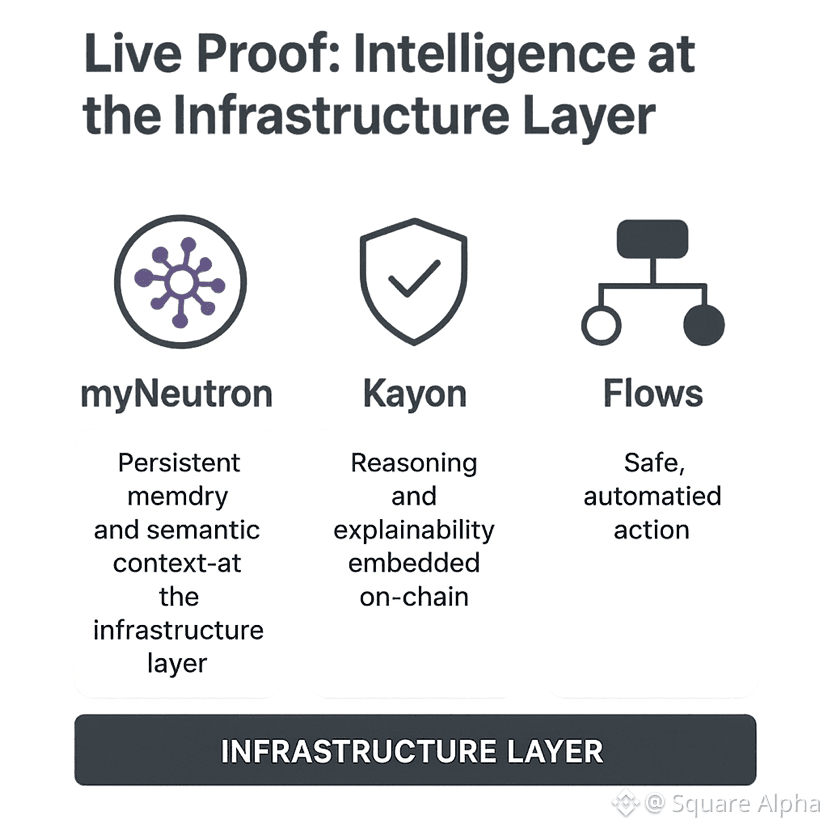
Live Proof: Intelligence at the Infrastructure Layer
This isn’t theoretical. Vanar already has live products proving AI readiness:
myNeutron
Demonstrates that persistent memory and semantic context can exist at the infrastructure layer. This is critical for AI agents that must maintain identity, learning, and continuity across interactions.
Kayon
Shows that reasoning and explainability can be embedded natively on-chain. AI systems that cannot explain decisions will never be trusted at scale. Kayon directly addresses that problem.
Flows
Transforms intelligence into safe, automated action. This is where AI stops being analytical and starts being operational — executing workflows without manual triggers.
Across all three, VANRY underpins usage — not as a speculative asset, but as the settlement and coordination layer across the intelligent stack.
Why Payments Complete AI-First Infrastructure
AI agents don’t open wallets.
They don’t click buttons.
They don’t sign transactions manually.
They require programmatic, compliant, global settlement rails.
Payments are not an add-on — they are a core requirement for AI-native systems. Without reliable value transfer, intelligence cannot operate economically.
VANRY is positioned exactly here: enabling real economic activity, not demos or test environments. As AI agents transact for compute, data, services, or execution, value must settle cleanly. That’s where readiness turns into revenue.
Cross-Chain Availability: Why Base Matters
AI-first infrastructure cannot remain isolated.
Vanar’s expansion cross-chain, starting with Base, is a strategic unlock. It exposes Vanar’s technology to:
broader developer ecosystems
larger user bases
real production environments
This significantly expands the usage surface for VANRY beyond a single chain. Intelligence scales horizontally — and infrastructure must follow.
Cross-chain availability turns Vanar from a network into a platform layer for intelligent systems, wherever they operate.
Why New L1s Will Struggle in an AI Era
Here’s the uncomfortable reality:
We don’t need more base infrastructure.
We need proof of AI readiness.
Launching a new L1 without intelligence baked in is like launching a mobile OS without internet. The market has moved on.
Vanar doesn’t need to convince users it’s AI-ready — it demonstrates it with live systems. That’s why VANRY reflects readiness, not hype cycles.
Final Thought: Readiness Beats Narrative
VANRY isn’t positioned around short-lived trends.
It represents exposure to AI-native infrastructure built for agents, enterprises, and real usage.
As the market shifts from storytelling to functionality, assets aligned with actual readiness will separate from those built on narrative momentum alone.
Vanar isn’t chasing the AI wave.
It’s building the rails intelligence will run on.
That’s where long-term value accrues.
@Vanarchain | $VANRY | #vanar
